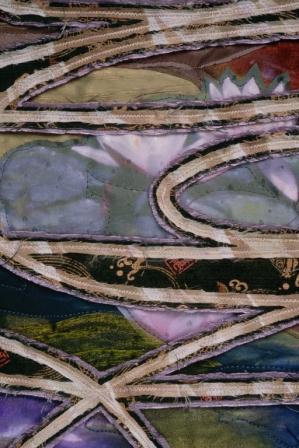
I live a circular life. From my previous post you can see that I use my understanding of the elements and principles of art to create and analyze landscape designs. But from my artwork pictured here, a detail from my fiber piece Summer Sojourn, You can see that my work as a landscape designer informs my art. I spend a lot of time looking at the world around me, and I work hard to really see it. The trick is to learn to then visualize things that may be hidden from view, or better yet, as they could be.
I live a circular life---not that there's anything wrong with that!
Evaluate your Landscape

This is the perfect time of year to evaluate your landscape. Most plants still have all of their foliage and are in full form. Walk your property and take photographs, preferably with a digital camera, of your favorite spaces and/or plant combinations. Take photos of the areas that bug you, too. Sometimes having a two dimensional image to look at allows you to "see" it differently than when you're actually out in the space or even viewing it from a window.
You can use your photos in several different ways. First, compare your favorite landscape areas with those that are a "problem." What are the differences? Look for contrast in plant height, form, or texture---is there enough of it? If you are comparing flower plantings you could also check for bloom density and color combinations.
Next, and here's where those digital images are ideal, convert your photos to black and white. The exclusion of color will allow you to look at your plantings, again, with a totally new eye. Check again for contrast in sizes and shapes of plants, foliage and flowers. Now also look for repetition. By repeating the use of a specific plant, say a shrub or an ornamental grass, throughout the entire landscape, you create a visual thread that ties everything together. Also, by repeating the use of individual plants by planting them together in groups you can create more visual impact and your garden will "read" more clearly.
Finally, use your photos to create a season- by- season (or even month-to-month) record of your landscape. You can then refer to this at any time to plan your next, best, outdoor project!
Yummy Harvest
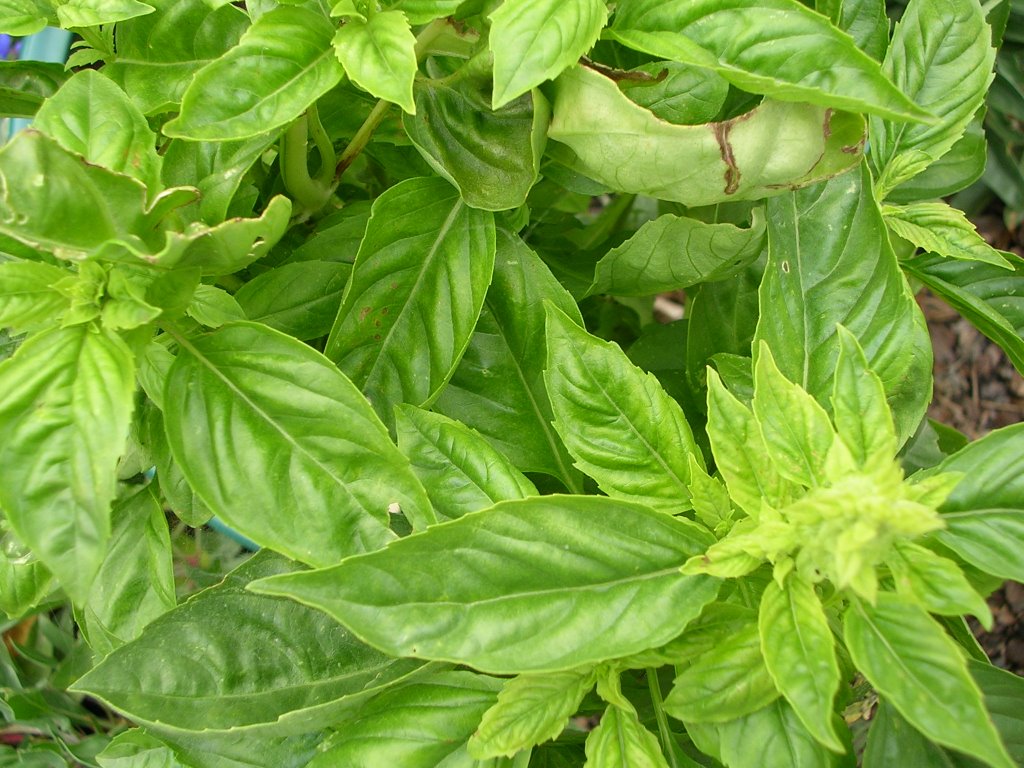
My husband, Jim, is the Pesto King! He raises basil in containers (much more successful in our sandy soil than in-ground cultivation) every summer and whips up several batches of pesto that he freezes in small batches for year 'round enjoyment. Here's his favorite recipe:
In food processor, combine:
2 cups fresh basil leaves, packed
4 large cloves garlic, peeled
1 cup mixed cocktail nuts (yes!)
Drizzle in 1 cup extra virgin olive oil, on slow speed
Add 1 1/4 cups grated Parmesan cheese in small batches, processing briefly.
Today will be his second harvest of the summer. Hopefully he'll get a bit more in a few weeks---if he remembers to use the floating row covers!
Be Prepared
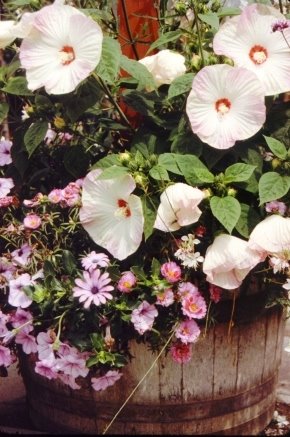
Today's cool, damp weather is a good reminder that our first frost is not that far away---typically September 30 for the Denver area. While you're out and about this weekend you might want to stop by your local garden center and pick up a floating row cover or frost blanket. These light weight, permeable, reusable throws are just the thing to have on hand to drape over your annual flowers and tender vegetables when frost threatens. There's nothing worse than seeing a great crop of basil or beautiful patio containers turned into mush over night!


