Showing posts with label out and about. Show all posts

Landscape Design Focus: Modern

Last summer, when I attended the annual Wheat Ridge Garden Tour, I was thrilled to have the opportunity to explore a beautifully designed and built modernist landscape.  The site is challenging; a sloping corner lot with a "built-over/walk-out" garage.  The 1950's era home features classic mid-mod geometry and deep roof overhangs.   In a nod to our region, pink flagstone was used as a decorative accent on the facade.

The homeowners worked with Los Angeles based landscape architect, Charles Elliott, and Kevin Bound of the local landscape design-build firm, Artscapes, to get a simple, elegant, low maintenance design and high quality installation.

Slopes were terraced with flagstone retaining walls and filled with colorful plantings, making access to both the front entry and the backyard most welcoming:


The backyard features multiple play areas for the family's young children.
A concrete "sport court" (in the foreground), a play structure with soft landing (upper right), and just enough level lawn area means lots of play space for everyone.
Distinctive dining and lounging areas are joined by a "soft" patio.
A platform deck floats over the sloping grade and minimizes damage to tree roots.
Use a bunch grass (like turf-type tall fescue) for this type of planting rather than a sod forming grass (like Kentucky bluegrass) for lower maintenance (less trimming).
The original flagstone patio features vintage furniture, too!
The use of the cast concrete squares throughout the landscape is a nice unifying element — and a much more economical choice than cut flagstone.  They serve as a practical surface for stepping stones, and a decorative accent in larger areas of gravel mulch.

The limited plant palette and row plantings enhance the geometry of the house and make for lower maintenance, too.
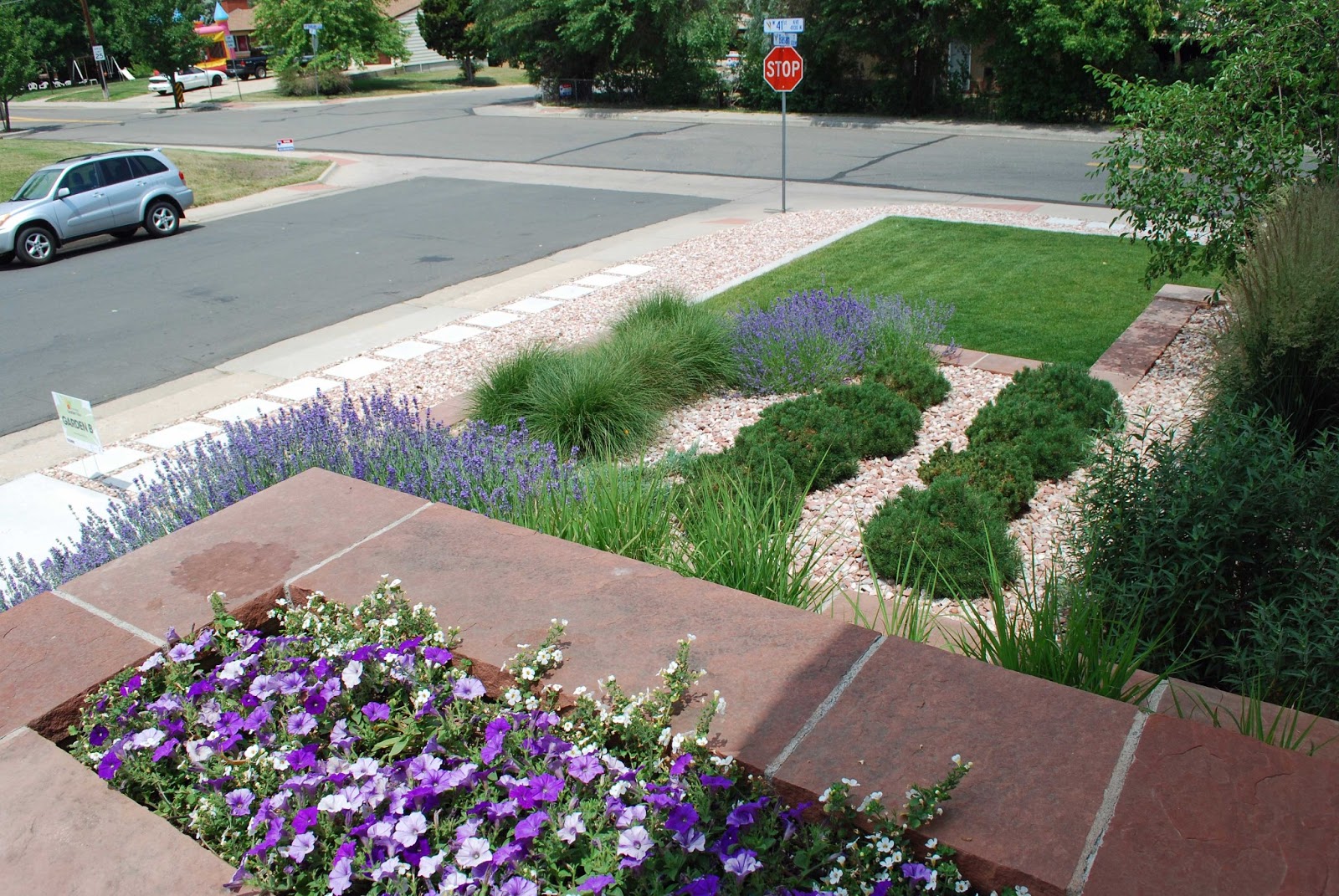
Purple-blue is the key color for the entry garden, filled with xeric lavender, bluemist spirea, grasses, and mugo pine.
For those of you considering a minimalist, modern style, remember these key concepts:
  • proper scale
  • very limited palette of hardscape materials, harmonious to home
  • geometric shapes for planting beds and hard surface areas
  • limited palette of plant material
Thanks to the Mead family for sharing their beautiful, distinctive landscape with us!


Comments Off

Missing June

· Posted in , ,

Do you miss your June garden?  Wishing you could turn back the clock and enjoy all your lovely flower faves again? Well, you can!  All you need to do is head up to Colorado's high country. Last weekend we took a day-trip from Denver to Fairplay / South Park (yes, that South Park), on through Breckenridge, and home via Frisco.

In Fairplay (elevation 9,953 feet), a tiny unpaved corner of the old stone county building has a spunky display of delphinium, alpine poppy (Papaver nudicale), columbine, Campanula spp., and snow-in-summer (Cerastium tomentosum).  The discovery of this little pocket garden was almost as exciting as the llama races!


The historic district of Breckenridge (elevation 9,600 feet) puts on a beautiful show for the summer tourists with gorgeous hanging baskets and flower boxes dripping with color (I was too stunned to take photos?  Doh!) Cottage style gardens are tucked into any little space available.  This garden includes blooms of cat mint (Nepeta spp.), larkspur, globe flower (Trollius spp.), foxglove, Veronica spp. and Dianthus spp.

Delphinium, lady's mantle (Alchmilla mollis), and Lilium spp. as well.

 Gardening at high elevations is challenging:  the growing season is very short, the nights are cool, and the sun is intense with a capital I ... but the rewards are huge.

(Frisco is on the shore of beautiful Lake Dillon, an important reservoir for metro Denver and the home of one of our favorite BBQ joints: Q4U.)


Comments Off

Got Stone?

Last Saturday was cool and cloudy, a perfect day to visit Tribble Stone.  Located at the base of the foothills between Boulder and Lyons, Tribble is a great resource for Colorado flagstone (sandstone). They carry both the rose and buff colors, and do custom cutting right on the site.

cut stone in the foreground, "random"  (as in shapes) in the back
Here's a flagstone slab right out of the quarry.  It's about 10" thick and will be split into 3 or 4 pieces by chiseling along the edge and exploiting a natural fault line.
Jim, for scale! Note the natural cracks/faults in the slabs
Or it might go straight to the cutter.  This is a pneumatic chop blade. Awesome!  This is how dimensional stone is cut; 2'x2', 3' x 2' 18" x 18" or whatever you need, it's made to order.
8" thick slab ready to be cut.  Any guesses why this equipment is buried?

Left over bits and bobs? Not great for structural building, but beautiful as a textural element when applied as a veneer to buildings, columns, fireplaces, 
Odd sizes await the creative builder.
or...pots!

Their chokecherries were in fine form, too!
native chokecherry, Prunus virginiana


Note: This article was not endorsed or compensated in any way by Tribble Stone.


Comments Off

Cool Art in the Gardens


Has the heat got you down — feeling a bit wilted, drained, limp?  Our garden is looking a bit on the crispy side these days (and that's how I feel, too), so after a very hot day last week, a picnic at Denver Botanic Gardens sounded like a refreshing treat. We were not disappointed.

The gardens themselves were lovely — full to bursting with flowering plants, shady alcoves, and cooling water features. And I really loved the fantastic art installations. Not only are they large-scale abstract sculptures (not everyone's cup of tea, I know) that were built on site, they are made out of plants — bamboo, specifically.

Tetsunori Kawana created organic pieces that speak to the rolling prairies and foothills; billowing clouds and winds of the Denver region.


Contrasting lines and shapes, hard textures and soft. Stone sculpture by Colorado artist Frank Swanson.


Stephen Talasnik 's more architectural creations bridge water and sky.  Sky, we have a lot of; water, we crave.  A conduit is what we need, indeed.


I will enjoy watching these sculptures weather over the next few months (the installation lasts through November 4).  Already, the bright green bamboo of spring has taken on the golden hues of summer.

Visit Denver Botanic Gardens (check their website, as hours vary daily) and see what you can see.  I'd love to hear about your discoveries!

Note: this review is my express opinion and was not authorized, endorsed, or paid for by Denver Botanic gardens nor the artists mentioned.

Comments Off

More from Sloan's Lake

· Posted in ,


The new jetty project at Denver's Sloan's Lake Park includes an observation/picnic area at the end of the promenade. I like the shade structures that were selected for this small space:

The scale is appropriate to the size of the area

The sail-like material and shape of the canopy is appropriate to the setting

The form of the support structures echo the branching of nearby trees and the wings of the ubiquitous Canada geese.

I predict that this new space will become a very popular asset for the park and its visitors!

Comments Off

Shocking! Or at least a bit disappointing...

A few weeks ago I wrote about American Sycamore, Platanus occidentalis, here and noted that it isn't a particularly good tree choice for this region.  Imagine my surprise when I discovered that London Plane TreePlatanus  x acerifolia (a cross between P. occidentalis and P. orientalis) has been planted en masse at the newly constructed Sloan's Lake jetty.  According to "Dirr's Hardy Trees and Shrubs", this is the most widely planted shade tree in cities worldwide. However, in his earlier (1977 edition) "Manual of Woody Landscape Plants" he opines that the landscape value is "limited" and that he would "hesitate to recommend this tree for anything."  My guess? This planting was designed by a landscape architect with little horticultural knowledge or understanding of the climate/growing conditions of the Denver area. But, hey, if they survive this could become a beautiful, shady promenade. 

multi-colored, peeling bark, characteristic of Platanus, is evident even on these young trees
 double fruit was key to the identification of this tree (the fruit of P. occidentalis is single)
 I'll keep my fingers crossed!

Comments Off

Meet . . . Platanus!

 a mature sycamore tree in Denver, Colorado

This plant profile is a bit different because it features a plant that I do not recommend. However, it's a plant that I think is visually intriguing and worthy of closer examination if you happen across one.
Platanus occidentalis, American sycamore, is native to eastern North America. It's found in deep, moist soils - not a characteristic of Colorado's front Range - and is very large, 75 to 100 feet tall with a similar spread - so not great for most residential landscapes, either.  This specimen is located in an irrigated park (32nd Ave and Federal Blvd, Denver) with plenty of room to grow. The texture is irregular and coarse with rangy branching and large leaves.


These trees definitely fall into the "messy" category. There's a mature sycamore in a yard right around the corner from me; I walk by that property all the time and I've noticed the constant litter of twigs (and branches after snow storms).

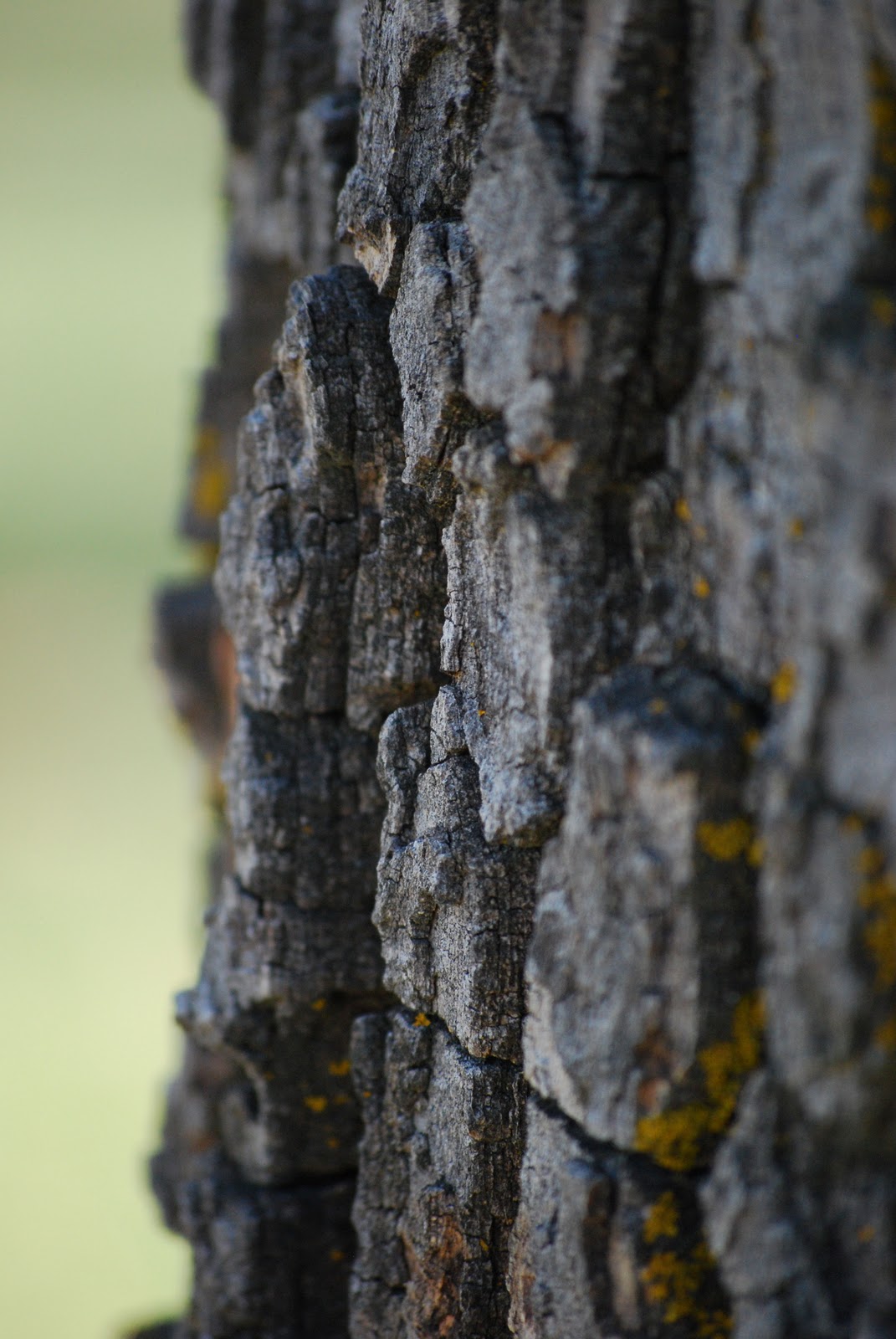
The beauty of a sycamore is in the amazing bark, which shifts from chunky, grey tessellations on the trunk to large, multicolor, flaky sheets on the lower branches, to smooth creamy-white bark on the upper-branches.


love the lichen on the north side of this old tree!


hues of warm browns, greys, and cream


And did I mention the cool fruit? Another sculptural component of Platanus.

Keep your eyes open for sycamore trees and enjoy them when you see them - just don't plant one!

Comments Off

Garden Designers' Roundtable: Darkness


The shadows know . . . !
a small courtyard garden is visually enlarged - and enhanced - by its shadow. Casa Benavides Inn, Taos, New Mexico

As the days of autumn shorten, the low-slung sun casts longer and more distinctive shadows. The play between positive and negative space becomes more exaggerated; an even match for the color drama going on now, too.

Shadows help us see forms. Various textures and shapes reflect and collect light differently allowing us to distinguish unique elements amongst landforms, hardscapes and plants.

dunes at White Sands National Monument


enhanced shadows expose the topography


shadows created by the foliage texture of this kale help us analyze and understand the plant's form
the variety of textures and forms in this garden create shadows that make it more readable

Shadows cast upon a vertical surface create a multiplying effect that gives depth to a garden. They can also provide new interest and beauty to a blah surface.

Allium shadows on brushed stainless steel at Kevin Robb Studios


the shadow of an tree creates the illusion of a climbing vine

Shadows cast upon a horizontal surface heighten the textural nuances of the hardscape material and create a distorted echo of the item itself.


ghostly images from vintage iron posts enhance a plain-Jane concrete patio

a lattice shadow on river pebbles has a watery distortion


Another type of "shadow" is a silhouette. Items back-lit by the sun and viewed through a translucent screen have a fascinatingly different appearance -  sometimes simplified, sometimes more complex.  (Either way, it does give one the sense of having x-ray vision.)

hidden flower buds, exposed

colors and shapes interplay like multiple layers of stained glass - Denver Botanic Gardens

a tangle of grape vines, simplified

Our landscapes are changing rapidly now.  As autumn moves into winter, and darkness dominates our days, I hope you will seek out the shadows and enjoy their stories.

Please visit my fellow members of the Garden Designers' Roundtable for more inspiring ideas and information on our theme of Darkness:

Lesley Hegarty & Robert Webber : Hegarty Webber Partnership : Bristol, UK
Genevieve Schmidt : North Coast Gardening : Arcata, CA

Thanks to M. Zwalen and M. Komodore for allowing me to photograph their gardens!

Comments Off
garden share bristol. Powered by Blogger.